


After a truck accident on I-37, get to safety, call 911, and get medical care, then document the truck’s USDOT number, the crash location, and any witnesses before vehicles are moved. Avoid recorded statements to the trucking company’s insurer. Because key evidence like driver logs and dashcam footage can disappear quickly, talk to a truck accident lawyer early.
Reviewed by David Burkett, personal injury trial attorney, 40 years representing injured people across the Coastal Bend and South Texas. Last legally reviewed October 2026.
If you were hit by an 18-wheeler on I-37, the steps you take in the first hours and days can decide whether you are able to prove what happened and recover full compensation. Interstate 37 carries a steady stream of tanker trucks, oilfield haulers, and freight rigs between the Port of Corpus Christi and San Antonio, and crashes on this corridor tend to be severe. The checklist below walks through what to do, in order, and why each step matters under Texas law.
Why Truck Crashes on I-37 Are Different
I-37 runs roughly 140 miles from downtown Corpus Christi to San Antonio, passing Refinery Row along the Nueces River, Calallen, Mathis and Lake Corpus Christi, George West, Three Rivers, and Pleasanton. Much of that stretch is rural, high-speed, and lightly lit at night. It is also a primary route for trucks serving the Port of Corpus Christi, the refineries on the city’s north side, and Eagle Ford Shale operations across Live Oak, McMullen, and Atascosa counties.
That mix creates specific risks: fatigued drivers finishing long hauls, heavy tankers that need far more distance to stop, merging conflicts at interchanges like US 77 near Calallen and US 59 and US 281 near George West, and long gaps between exits where help can take time to arrive. It also affects your claim. A crash near Three Rivers is usually worked by Texas Department of Public Safety troopers, while a crash inside Corpus Christi city limits is typically handled by the Corpus Christi Police Department. Knowing which agency responded tells you where your crash report will come from.
Step 1: Get to Safety and Call 911
If you can move, turn on your hazard lights and get yourself and your passengers away from traffic, ideally behind a guardrail or well off the shoulder. Secondary crashes are a real danger on I-37, where traffic approaching a wreck at 75 miles per hour may not see stopped vehicles in time. Call 911 even if injuries seem minor. In Texas, you must report crashes involving injury or death, and a law enforcement crash report becomes one of the most important documents in a truck accident claim.
Step 2: Get Medical Care, Even If You Feel Fine
Adrenaline masks pain. Neck and back injuries, internal bleeding, and traumatic brain injuries often do not show symptoms until hours or days later. Accept transport if paramedics recommend it, or see a doctor the same day. Prompt treatment protects your health and creates a medical record linking your injuries to the crash. Trucking insurers routinely argue that a gap in treatment means the injuries came from something else.
Step 3: Document the Truck and the Scene
If you can, use your phone to capture evidence before the scene is cleared. Focus on details that are unique to commercial vehicles:
- The USDOT number and company name painted on the cab door, plus the trailer number and license plates on both the tractor and the trailer.
- Photos of all vehicles from several angles, skid marks, debris, cargo spills, road conditions, and the nearest mile marker or exit sign.
- The truck driver’s name, commercial driver’s license information, and insurance details.
- Names and phone numbers of witnesses, including other truck drivers who may have seen the crash.
Do not argue about fault at the scene or apologize. Even a polite “I am sorry” can later suggest you admitted responsibility.
Step 4: Get the Crash Report Information
Before leaving, ask the responding officer for the agency name and the report or case number. Texas officers document injury crashes on the Texas Peace Officer’s Crash Report, known as the CR-3, which you can request through TxDOT once it is filed. The report will list the parties, insurance, the officer’s observations, and contributing factors. It is not the final word on fault, but insurers lean on it heavily.
Step 5: Do Not Give a Recorded Statement to the Trucking Company’s Insurer
Trucking companies and their insurers often send adjusters or investigators within a day or two of a serious crash. They may sound helpful, but their job is to limit what the company pays. You are not required to give a recorded statement to the other side’s insurer, and anything you say about your speed, your injuries, or what you saw can be taken out of context. Report the crash to your insurer as required by your policy, and let a lawyer handle communications with the trucking company.
Step 6: Act Fast to Preserve Trucking Evidence
This step is where truck cases differ most from car accidents. Commercial carriers generate records that can prove fatigue, speeding, poor maintenance, or unsafe hiring, but much of it can be lawfully discarded or overwritten if no one asks for it in time.
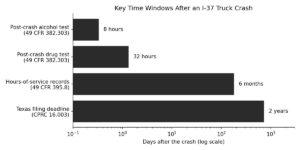
Federal rules require post-crash alcohol testing within 8 hours and drug testing within 32 hours in many serious crashes, and carriers only have to keep hours-of-service records for six months. Dashcam video, engine control module data, and GPS tracking can be lost even sooner. A truck accident attorney can send a preservation letter to the carrier right away, putting the company on notice that destroying evidence will have consequences.
| Evidence | What It Can Show | Who Holds It |
|---|---|---|
| Electronic logging device (ELD) data | Hours driven, rest breaks, and possible fatigue violations | Trucking company |
| Engine control module (black box) | Speed, braking, and throttle in the seconds before impact | Truck and carrier |
| Dashcam and in-cab camera footage | Driver distraction, lane changes, and road conditions | Carrier or camera vendor |
| Driver qualification file | CDL status, training, prior violations, and drug test history | Trucking company |
| Maintenance and inspection records | Brake, tire, and lighting defects | Carrier or maintenance contractor |
| Cargo and loading documents | Overweight or improperly secured loads | Shipper, broker, or loader |
Step 7: Track Your Losses
Keep every medical bill, prescription receipt, and mileage log for trips to appointments. Save pay stubs and a note from your employer showing missed work. A simple daily journal describing your pain, sleep, and the activities you can no longer do helps document non-economic damages that are otherwise hard to prove. If you work in the oilfield, at the port, or in another physical job, note any duties you cannot perform.
Step 8: Understand Who May Be Responsible
Truck crashes often involve more than one at-fault party. Depending on the facts, liability may extend to the driver, the motor carrier, a freight broker, the shipper that loaded the trailer, a maintenance company, or the manufacturer of a defective part. Our guide on who is at fault in a Corpus Christi truck accident explains how investigators sort this out, and many I-37 crashes involving lane changes trace back to a driver failing to check a truck’s blind spots.
Texas also has special trial rules for commercial vehicle cases. Since 2021, a trucking company can ask the court to split the trial so evidence of its own negligence in hiring or supervision is heard only in certain circumstances. We explain those changes in our article on how Texas law limits when trucking companies are liable. Where a carrier knowingly put a dangerous driver or truck on the road, a claim for gross negligence may also be available.
Step 9: Watch the Deadline
In most Texas personal injury cases, you have two years from the date of the crash to file a lawsuit. Our page on the Texas personal injury statute of limitations covers the exceptions. Two years sounds like plenty of time, but truck cases require extensive investigation, and the evidence windows described above close long before the filing deadline does.
What David Burkett Tells Clients After an I-37 Truck Crash
“The first call most people get after a truck wreck on 37 is not from a lawyer. It is from the trucking company’s insurance adjuster, sometimes before the injured person is even home from the hospital. The trucking company already has its people working the case. We tell clients the same thing every time: get your medical care, do not give a statement, and let us lock down the logbooks, the black box, and the camera footage before it disappears. On a long rural stretch like the one between Mathis and Three Rivers, that data is often the only independent witness to what really happened.” David Burkett, The Burkett Law Firm
Common Causes of Truck Accidents on I-37
| Cause | How It Happens on I-37 |
|---|---|
| Driver fatigue | Long hauls between the Port of Corpus Christi, San Antonio, and Eagle Ford sites push drivers toward hours-of-service limits |
| Following too closely | Loaded tankers cannot stop in time when traffic slows near interchanges or work zones |
| Unsafe lane changes | Trucks merging at US 77, US 59, or US 281 fail to see vehicles in their blind spots |
| Overloaded or unsecured cargo | Oilfield equipment and bulk loads shift or spill on curves and ramps |
| Poor maintenance | Brake and tire failures on heavy, high-mileage rigs |
| Speeding on rural stretches | High speeds on long, straight segments reduce reaction time |
Recent Truck Crashes Reported on I-37
Publicly reported crashes show how serious these collisions can be along the corridor:
| Date | Location | What Was Reported |
|---|---|---|
| April 27, 2020 | About four miles north of Three Rivers, Live Oak County | A northbound tractor-trailer left the roadway and went down an embankment; the driver died after being flown to San Antonio (DPS via KRIS 6 News) |
| February 21, 2022 | About three miles southwest of Three Rivers, Live Oak County | A northbound SUV struck the trailer of a semi-truck at night; the SUV driver was killed (Texas DPS) |
| April 3, 2023 | Northbound I-37 approaching I-35, San Antonio | An 18-wheeler rear-ended a car stopped in traffic, causing a five-vehicle chain reaction; one passenger was killed |
If a trucking company is already building its defense, you need someone building your case. The Burkett Law Firm handles truck accident claims throughout the Coastal Bend and along the full length of I-37, and we move quickly to preserve the evidence that proves fault. [Insert verified case result here.] Call (361) 882-8822 to talk with our team.
Frequently Asked Questions
Who investigates a truck accident on I-37?
It depends on where the crash happened. Inside Corpus Christi city limits, the Corpus Christi Police Department usually responds. On rural stretches through San Patricio, Live Oak, and Atascosa counties, Texas Department of Public Safety troopers typically investigate. In serious commercial vehicle crashes, DPS may also inspect the truck for safety violations.
How do I find out which trucking company owns the truck?
Look for the USDOT number on the side of the cab. That number can be searched in the Federal Motor Carrier Safety Administration database to identify the carrier, its insurance filings, and its safety record. The crash report should also list the carrier.
How long do I have to file a truck accident lawsuit in Texas?
Most claims must be filed within two years of the crash. Some exceptions can shorten or extend that period, so it is best to speak with a lawyer well before the deadline, especially because key trucking evidence can be lost within weeks or months.
Can I still recover if the truck driver says I caused the crash?
Yes, if you were not more than 50 percent at fault. Texas reduces your recovery by your percentage of fault but does not bar it unless your share exceeds half. Evidence like ELD data and dashcam footage often contradicts a driver’s account.
What compensation is available after an 18-wheeler crash?
Injured people may recover medical expenses, lost wages and lost earning capacity, pain and suffering, mental anguish, physical impairment, and property damage. In cases involving gross negligence, exemplary damages may also be available. Families who lose a loved one may bring a wrongful death claim.
Should I talk to the trucking company’s insurance adjuster?
You can share basic contact and vehicle information, but you are not required to give a recorded statement or sign medical authorizations for the other side’s insurer. Those requests are best handled by your attorney.
Do I need a lawyer if my injuries seem minor?
Not every crash requires a lawsuit, but truck cases involve commercial insurers, federal regulations, and evidence that disappears quickly. A free consultation can help you understand the value of your claim before you accept any offer.
Is It Too Early or Too Late to Call a Lawyer?
“I do not want to be the kind of person who sues.” A claim against a trucking company is usually paid by its commercial insurance, which federal law requires most interstate carriers to carry in amounts of at least $750,000. Holding the carrier accountable means your medical bills and lost income are paid, rather than falling on your own health insurance or savings.
“The insurance company already made me an offer.” Early offers often arrive before the full extent of an injury is known. Once you accept and sign a release, you generally cannot reopen the claim, even if you later need surgery. It costs nothing to have an offer reviewed before you sign.
“I think I might be partly at fault.” Texas uses a modified comparative fault rule. You can still recover damages as long as you are not more than 50 percent responsible, although your recovery is reduced by your share of fault. Trucking insurers often overstate a driver’s share, so don’t assume you have no case.
What to Expect When You Call The Burkett Law Firm
When you call, a member of our team will listen to what happened, ask where on I-37 the crash occurred, which agency responded, and what injuries and treatment you have had so far. The consultation is free, and you won’t pay unless we recover compensation for you. You will leave knowing whether you have a claim, what evidence to preserve right away, and what the next steps look like.
Talk to a Corpus Christi Truck Accident Lawyer
A truck accident on I-37 can change your life in seconds, and the trucking company starts protecting itself just as quickly. The Burkett Law Firm has represented injured people in Corpus Christi and across South Texas for decades. Learn more about our Corpus Christi truck accident lawyers, call (361) 882-8822, or contact us online for a free consultation. [Insert verified case result here.]
