

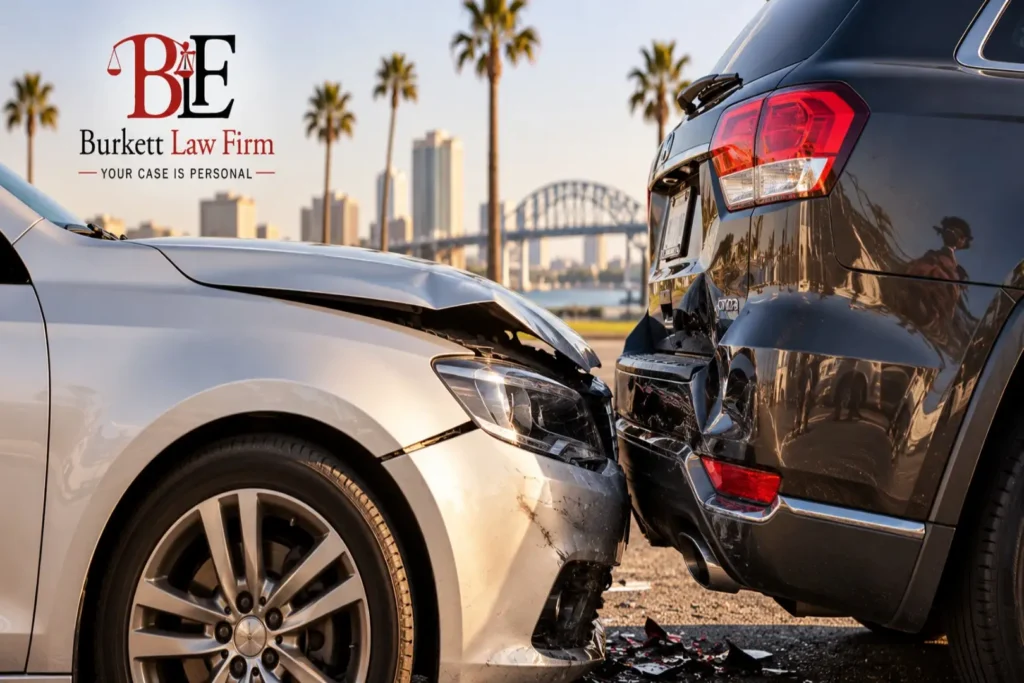
In most Texas rear-end collisions, the rear driver is at fault because state law requires drivers to keep a safe following distance. But fault is not automatic. A lead driver who brake-checks, cuts in and stops, reverses, or drives with broken brake lights can share responsibility or be fully liable. Texas uses a 51 percent bar rule, so partial fault reduces your recovery. A Corpus Christi car accident attorney can help prove who caused the crash.
Many people assume the driver in back is always to blame when one car hits another from behind. That assumption is usually right, but not always, and the exceptions matter when an insurance company is looking for a reason to reduce what it pays. Understanding how Texas decides fault in these crashes helps you protect your claim from the start. If you were injured in one of these crashes, our Corpus Christi rear-end car accident lawyers can review how fault applies to your situation.
The Starting Point: Texas’s Following Distance Law
Texas Transportation Code § 545.062 requires a driver who is following another vehicle to maintain an assured clear distance between the two vehicles. That distance must be enough that, given the vehicles’ speed, traffic, and road conditions, the driver can stop safely without colliding with the vehicle ahead or veering into another vehicle, object, or person.
In plain terms, every driver must leave enough space to stop if the car ahead stops. In a rear-end collision, the most common explanation is that the rear driver did not leave that space, often because of distraction, speed, or tailgating. That is why the rear driver is usually found responsible.
Why the Rear Driver Is Not Automatically at Fault
Here is where Texas law surprises many people. Texas courts have long held that a rear-end collision alone does not prove the rear driver was negligent. The injured person still has to show what the rear driver did wrong, such as following too closely, driving too fast for conditions, or failing to pay attention.
In most cases, that proof is not hard to find. But it also means the rear driver can argue that the lead driver caused or contributed to the crash. Insurers use these arguments regularly, so it helps to know what they look like.
When the Lead Driver Can Be at Fault
The driver in front has responsibilities too. Situations where the lead driver may share fault, or bear all of it, include:
- Brake-checking. Slamming on the brakes for no traffic reason, often out of anger at a tailgater, can make the lead driver responsible for the collision that follows.
- Cutting in and stopping. A driver who swerves into a lane directly in front of another car and immediately brakes may leave the rear driver no reasonable chance to create a safe gap.
- Broken brake lights. Texas requires vehicles to have working stop lamps. If the lead vehicle’s brake lights were out, the following driver may not have had warning that the car was stopping.
- Reversing. When a driver backs up into a stopped car, such as in a parking lot or after missing a turn, the front vehicle caused the crash.
- Stopping illegally. Stopping in a travel lane on a highway without a reason, or pulling out of a driveway directly into the path of traffic, can shift fault to the lead driver.
The table below summarizes how fault is commonly analyzed in different rear-end scenarios. Every case turns on its own facts, but these patterns show why the answer is not always as simple as it seems.
| Scenario | Who Is Usually Responsible | Why |
|---|---|---|
| Rear driver was texting, speeding, or tailgating | Rear driver | Failed to keep an assured clear distance and pay attention to traffic ahead |
| Lead driver stopped normally for traffic or a light | Rear driver | A normal stop is exactly what following drivers must be prepared for |
| Lead driver cut into the lane and braked immediately | Lead driver, or shared | The rear driver may not have had a fair chance to create a safe gap |
| Lead driver brake-checked the rear driver | Lead driver, or shared | Intentionally slamming on the brakes without reason is dangerous and can be negligent |
| Lead driver’s brake lights did not work | Shared | Texas requires working stop lamps, and broken lights can mislead following drivers |
| Lead driver suddenly reversed | Lead driver | The collision was caused by the front vehicle moving backward |
| Chain-reaction crash on a highway | Often multiple drivers | Each driver’s following distance and reaction is evaluated separately |
How Shared Fault Works in Texas
Texas follows a proportionate responsibility system under Chapter 33 of the Civil Practice and Remedies Code, often called modified comparative fault. A judge or jury assigns each person involved a percentage of responsibility, and those percentages affect recovery in two ways:
- If you are partly at fault, your compensation is reduced by your percentage of responsibility.
- If you are found more than 50 percent responsible, you cannot recover damages from the other parties at all.
For example, suppose you were rear-ended and your damages total $100,000. If a jury finds the rear driver 80 percent responsible and you 20 percent responsible because one of your brake lights was out, you could recover $80,000. If the jury instead put 51 percent of the fault on you, you would recover nothing. That line is why insurers work so hard to shift even a small amount of blame onto the driver who was hit.
Chain-Reaction Rear-End Crashes
Multi-vehicle pileups are common on busy corridors in the Coastal Bend, including I-37, SPID, and the approaches to the Harbor Bridge. In a chain-reaction crash, the first rear driver often pushes one car into another, but each driver’s following distance and reaction are evaluated separately. A driver in the middle of the chain may be both a victim and partly responsible. These claims often involve several insurance companies, each trying to blame the others.
Other Parties Who May Be Responsible
Fault is not always limited to the two drivers. Depending on the facts, responsibility may extend to:
- An employer, if the rear driver was working at the time of the crash
- A trucking company, when a commercial truck caused the collision
- A vehicle or parts manufacturer, if defective brakes or another failure contributed
- A government entity or contractor, when a road hazard or poorly marked work zone played a role
Rear-end crashes involving commercial trucks carry much greater force and involve federal safety rules. Our page on rear-end truck accidents explains how those claims differ, and our guide to distracted driving accidents covers one of the most common reasons drivers fail to stop in time.
Evidence That Proves Fault in a Rear-End Crash
Because Texas does not presume the rear driver is negligent, the evidence you gather can decide the case. Useful evidence includes:
- The Texas Peace Officer’s Crash Report (CR-3), including any citations and the officer’s diagram
- Photos of both vehicles, showing where and how they were damaged
- Dashcam footage and nearby business or traffic camera video
- Witness names and statements
- Vehicle event data recorder information, which can show speed and braking before impact
- Phone records, when distraction is suspected
Much of this evidence disappears quickly, especially video that gets overwritten within days. Our article on knowing your rights after a rear-end car accident walks through the steps to take right after a crash, and our overview of Texas rear-end accident laws covers common injuries and compensation.
How Often These Crashes Happen in Nueces County
Crashes of all kinds are a daily reality in the Corpus Christi area. According to TxDOT’s 2024 crash data, Nueces County recorded 7,883 reportable crashes. Of those, 47 were fatal, 145 caused suspected serious injuries, and more than 2,000 others caused minor or possible injuries. Statewide, TxDOT reported a reportable crash every 57 seconds in 2024.
Source: Texas Department of Transportation, Crashes and Injuries by County, 2024.
Rear-end crashes are a common source of neck and back injuries, even at lower speeds. If you are dealing with neck pain after a collision, our page on whiplash injury claims explains how these injuries are documented and valued.
Is the insurance company blaming you for a crash you did not cause? Since 1960, The Burkett Law Firm has helped injured people across the Coastal Bend recover more than $80 million. Call 361-738-5548 for a free consultation.
Frequently Asked Questions About Fault in Texas Rear-End Collisions
Is the rear driver always at fault in a Texas rear-end collision?
No. The rear driver is usually found responsible because Texas law requires drivers to keep a safe following distance, but Texas courts have held that the fact a rear-end collision happened does not automatically prove the rear driver was negligent. The lead driver can share fault or be fully responsible in some situations.
What is the following distance law in Texas?
Texas Transportation Code § 545.062 requires a driver following another vehicle to maintain an assured clear distance, so that, considering speed, traffic, and road conditions, the driver can stop safely without hitting the vehicle ahead or veering into another vehicle, object, or person.
Can I still recover compensation if I was partly at fault?
Yes, as long as you are not more than 50 percent responsible. Under Texas’s proportionate responsibility rules, your compensation is reduced by your percentage of fault. If you are found 51 percent or more at fault, you cannot recover damages from the other drivers.
Does a police report decide who is at fault?
No. A Texas Peace Officer’s Crash Report, known as a CR-3, often includes the officer’s observations and any citations, and insurers rely on it heavily. It is important evidence, but it is not the final word on fault, and errors in a report can be challenged with other evidence.
Who pays if a company vehicle rear-ended me?
If the driver was working at the time of the crash, the employer and its insurer may be responsible in addition to the driver. Commercial policies often carry higher limits than personal auto policies, which can matter when injuries are serious.
How long do I have to file a rear-end accident claim in Texas?
In most cases, Texas gives you two years from the date of the crash to file a personal injury lawsuit. Claims involving government vehicles can require formal notice much sooner, so it is important to speak with an attorney quickly.
What Happens When You Call The Burkett Law Firm
When you call 361-738-5548, our team will ask a few questions about the crash, including where it happened, how the vehicles were positioned, whether police responded, and what injuries you are dealing with. We will set up a free consultation with one of our attorneys, who will review the crash report, photos, and insurance information and explain how Texas fault rules are likely to apply. You will leave knowing whether you have a claim and what to do next to protect it.
Talk to a Corpus Christi Rear-End Accident Lawyer
Who is at fault in a rear-end collision in Texas usually has a clear answer, but insurers will still look for ways to shift the blame. The Burkett Law Firm represents injured drivers and passengers throughout Corpus Christi and the Coastal Bend. If the at-fault driver lacked enough coverage, we can also help you pursue an uninsured or underinsured motorist claim. Keep in mind that Texas generally allows two years to file an injury lawsuit, so do not wait to get answers.
