

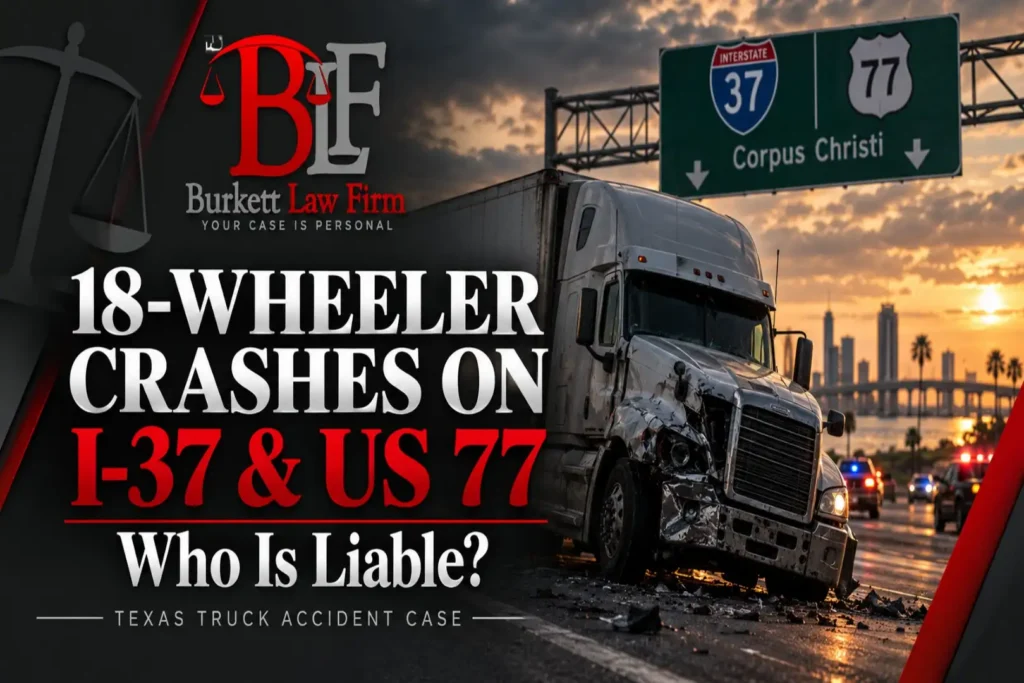
Corpus Christi sits at the meeting point of major freight corridors. Interstate 37 carries traffic to and from San Antoni; US 77 and US 281 run north through the Coastal Bend, and the port generates constant heavy truck traffic through the region.
When a fully loaded tractor-trailer collides with a passenger vehicle, the physics leave little room for a good outcome. The legal question that follows is rarely about the driver alone.
More Than One Defendant
A truck crash typically involves several potentially responsible parties, and identifying them determines whether adequate coverage exists.
- The driver, for negligent operation
- The motor carrier, both for the driver’s conduct and for its own hiring, training, supervision, and scheduling
- The company that owns the tractor or trailer, where different from the carrier
- The shipper or loader, where cargo was improperly loaded or secured
- A maintenance contractor, where mechanical failure contributed
- A parts or component manufacturer, in cases of defect
- A broker, in defined circumstances involving the selection of an unsafe carrier
Carrier liability matters most in practice. A claim against the company for negligent hiring, retention, training, or supervision reaches conduct beyond the moment of the crash — a driver kept on despite a poor record, a schedule that could not be met legally, a maintenance program in name only.
Federal Regulations Create the Evidence
Interstate motor carriers operate under federal safety regulations, and compliance generates documentation that would not otherwise exist. That documentation underpins these cases.
- Hours-of-service records and electronic logging device data
- Driver qualification files, including licensing, medical certification, and employment history
- Drug and alcohol testing records, including post-accident testing
- Vehicle inspection, repair and maintenance records
- Bills of lading, weight tickets and cargo securement documentation
- Dispatch records, GPS data and communications with the driver
- Onboard camera footage where the vehicle was so equipped
Electronic logging data is particularly valuable. It records driving time objectively, which makes fatigue provable rather than merely alleged. A driver who exceeded hours limits, or a carrier that dispatched a load that could not be delivered on time legally, is exposed by its own compliance records.
These Records Do Not Survive Long
Federal retention requirements for several categories of records are measured in months. Carriers are permitted to destroy material on schedule in the ordinary course, and much of it is.
A spoliation letter sent immediately by The Burkett Law Firm, identifying the specific categories to be preserved, is the single most important early step in a truck case. Once sent, destruction becomes a litigation issue rather than a routine practice.
Carriers understand this. Most large motor carriers dispatch a rapid response team to serious crash scenes within hours, sometimes before the vehicles have been cleared. Their investigators photograph, measure, interview, and download data while the injured party is still in the hospital.
An injured person who waits several months to consult a lawyer is entering a case where the other side has had an unopposed head start.
Cargo, Weight and Load Securement
Many Coastal Bend truck cases involve loads rather than driving.
Improperly secured cargo shifts, changing the vehicle’s handling and contributing to rollovers. Overweight loads extend stopping distances and stress brakes and tires. Liquid loads in partially filled tanks surge, affecting control in nonintuitive ways.
If a shipper or third-party loader prepared the load rather than the carrier, responsibility may extend to the shipper or third-party loader. Weight tickets, bills of lading, and loading records establish who did what.
Driver Qualification and Hiring
A carrier’s responsibility begins before the trip, in whom it puts behind the wheel.
Federal rules require carriers to maintain driver qualification files covering licensing, medical certification, road testing, and reviews of previous employment and driving history. Carriers must also conduct annual reviews of driving records.
When carriers perform those obligations superficially, the file shows it. A driver with prior serious violations, a lapsed medical certificate, or a history the carrier never checked supports a claim that goes beyond the crash itself to the decision to employ that driver.
Driver shortages create pressure to hire quickly and retain drivers who should have been removed, and that pressure is visible in the paperwork.
Post-Accident Testing
Federal regulations require drug and alcohol testing after qualifying crashes, within defined time windows.
Where testing was not conducted, or was conducted outside the required window, that omission is in itself significant. Carriers must document why a test was not performed when the rules required it.
Litigation can obtain results and testing records, and they are among the first items a preservation letter should identify.
Why Fault Is Contested So Hard in Texas
Because Texas bars recovery entirely when a claimant is more than 50% responsible, defense efforts focus on assigning fault to the passenger vehicle.
Common arguments include that the car merged too closely, was in the truck’s blind spot, braked suddenly, or was speeding. Some have merit, while others are constructed after the fact from ambiguous physical evidence.
Countering them generally requires reconstruction work, data from both vehicles, and careful analysis of the physical evidence at the scene. This is not an area where an adjuster’s initial assessment should be accepted as the final word.
Driver Fatigue and Scheduling Pressure
Fatigue is among the most common contributing factors in serious truck collisions, and it is also among the most provable.
Hours-of-service rules limit driving and on-duty time and require rest periods. Electronic logging makes violations visible in a way paper logs never did, and the data can be cross-referenced against fuel receipts, toll records, GPS, and delivery timestamps.
The more significant question is often why the driver was fatigued. Where a carrier set a schedule that could not be met within legal hours, or paid in a way that rewarded exceeding them, responsibility extends past the driver to the company that created the pressure.
Dispatch records and pay structures are discoverable, and they frequently tell that story clearly.
Rollovers and Underride Collisions
Two types of crashes recur on the highways around the Coastal Bend, and each raises specific issues.
Rollovers commonly involve speed on a curve or ramp combined with a high center of gravity, and cargo securement and load distribution are central to their occurrence. Ramp and curve advisory speeds for commercial vehicles differ from those for passenger cars, and drivers do not always observe the distinction.
Underride collisions, where a passenger vehicle travels beneath a trailer, are disproportionately fatal. Federal standards govern rear impact guards, and the condition, maintenance, and adequacy of that equipment become issues, as do the presence or absence of side underride protection and the visibility of reflective markings on the trailer.
Damages in Serious Truck Cases
Because the injuries are typically severe, the damages analysis is more involved than in an ordinary collision. Life care planning, vocational assessment, and economic analysis are frequently necessary to establish the true cost of a catastrophic injury over a lifetime.
Commercial policies are substantially larger than personal auto coverage, and layered excess policies often sit above the primary. Identifying every applicable policy is part of establishing what the claim can actually recover.
If you or a family member were hit by a commercial truck around Corpus Christi, the carrier’s investigators are already working. Call The Burkett Law Firm so someone can work for you.
We don’t charge a fee unless we recover for you, and the initial conversation costs nothing. It starts the preservation process while the records that decide these cases still exist.
