

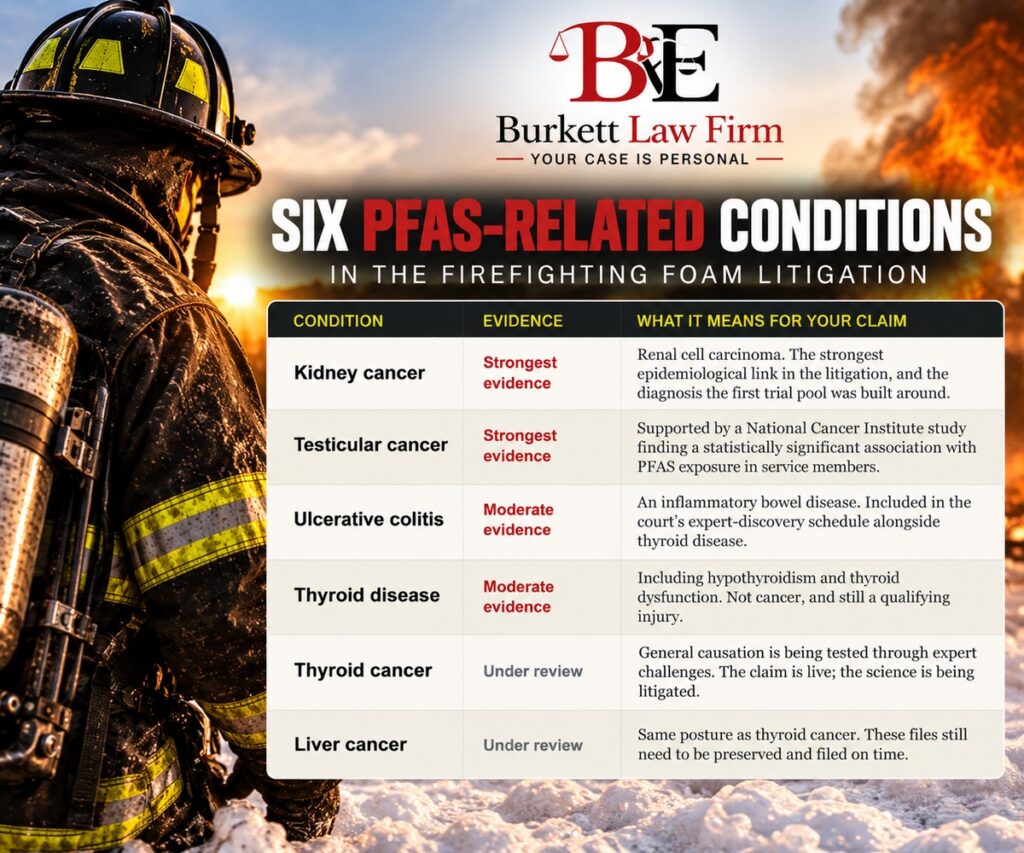
Firefighters can often prove AFFF exposure years later by combining department training and incident records, foam purchase and inventory logs, military or certification files, medical records, and statements from former coworkers. No single document usually carries a claim. The Burkett Law Firm can review what you remember and identify which records are worth pursuing.
Proving AFFF exposure is often the hardest part of a firefighter PFAS claim, especially when the exposure happened 20 or 30 years ago. A diagnosis can be documented in a single pathology report, but a career spent around firefighting foam is scattered across training logs, supply closets, personnel files, and the memories of people who have since retired. The good news is that exposure histories are rebuilt from pieces all the time.
This guide focuses on that rebuilding process. For an overview of which diagnoses are part of the federal litigation and who may qualify, see our main page on firefighter PFAS and AFFF lawsuits.
Why Exposure Evidence Carries So Much Weight
The federal AFFF cases are product liability claims against the companies that made PFAS chemicals and foam. In that kind of case, the defense will ask a basic question: how do we know this person was exposed to our product, and how much? A firefighter who says, “We used foam all the time,” is telling the truth for most of the profession. Records turn that truth into something a court can evaluate.
Exposure evidence generally has to answer three things. Where the firefighter served, how often they used or handled foam, and roughly when it happened. Frequency matters because repeated contact over a career looks very different from a single call. Timing matters because it helps identify which products were in use and because it connects to filing deadlines.
Start With Your Own Memory Before the Paperwork
Before anyone requests a single file, the most useful step is writing down what you remember while it is fresh. Many firefighters are surprised by how much comes back once they start. A simple timeline can include:
- Every department, station, base, airport, or plant where you served, with approximate years.
- Training burns you attended, how often they happened, and where the training grounds were.
- Specific fires involving fuel, aircraft, tankers, or industrial facilities where you deployed foam.
- Duties that put you in contact with foam after the fire, such as refilling tanks, washing hoses, or cleaning equipment.
- Names of captains, training officers, and crewmates who worked alongside you.
This list becomes the roadmap. It tells an attorney which agencies to contact, which years to focus on, and which witnesses may still be reachable.
Department and Municipal Records Worth Requesting
Municipal and county fire departments in Texas are public bodies, so you can request many of their records under the Texas Public Information Act. The categories that tend to matter most in AFFF cases include training logs and attendance rosters, incident reports for fuel or vehicle fires, and apparatus inventory sheets showing foam on board.
Purchase orders and supply invoices can be especially valuable. A department that bought Class B foam concentrate in bulk year after year left a paper trail showing what product it used and how much. Safety data sheets kept on file may also name the manufacturer. Many departments also submitted incident data to the National Fire Incident Reporting System, which can help confirm the types of calls a station handled.
Records retention schedules vary, and some older paper files were discarded long ago. That is one reason an early request matters, and why a law firm request often includes a letter asking the department to preserve what remains.
Military Firefighter Records
Military firefighters were among the heaviest users of AFFF, since military fuel-fire suppression specifications drove its use for decades. Along the Coastal Bend, that history includes naval aviation installations where aircraft rescue and firefighting crews trained and responded.
Veterans usually start with the DD-214, which confirms service dates and military occupation. You can request the complete service personnel file, which may include training records and duty assignments, from the National Personnel Records Center using Standard Form 180. Unit histories and base fire department records can add detail about training frequency and specific incidents.
Volunteer, Airport, and Industrial Firefighter Records
Firefighters outside large city departments often worry that no one tracked them. In reality, other sources can help. Volunteer departments usually maintain membership rosters and call logs, even informal ones. The Texas Commission on Fire Protection maintains certification records for certified fire protection personnel, which can confirm when someone completed training and where they served.
Airport rescue and firefighting crews trained under federal aviation requirements, and airports often kept documentation of those drills. Refinery and plant emergency response teams are a different situation because their records belong to private employers rather than public agencies. Those files are not available through public information requests, so they are usually obtained through the litigation process itself.
Medical Records That Tie the Diagnosis to the Timeline
Exposure is only half of the picture. The medical side of the file needs to establish the diagnosis, when it was made, and how it has been treated. Pathology reports, imaging results, surgical records, and oncology or gastroenterology notes all help. The date of diagnosis matters because it can affect when the Texas personal injury statute of limitations began to run in a latent disease case.
Where Records Come From: A Quick Reference
| Record Source | What It May Show | Who Usually Holds It |
|---|---|---|
| Training logs and rosters | Frequency of live-burn and foam training | Fire department or training academy |
| Purchase orders and invoices | Foam products used and quantities | City or county purchasing office |
| Safety data sheets | Manufacturer and product names | Department files or station records |
| Incident reports | Fuel, aircraft, and industrial fire responses | Department and reporting systems |
| DD-214 and service file | Service dates, duties, and training | National Personnel Records Center |
| Certification records | Training completion and service history | Texas Commission on Fire Protection |
| Pathology and treatment records | Diagnosis and date of diagnosis | Hospitals and treating physicians |
| Witness statements | Firsthand accounts of foam use | Former coworkers and supervisors |
Witnesses Who Can Fill the Gaps
When paper records are missing, people often are not. A retired training officer may remember exactly how often the department ran foam drills. A former supply officer may recall which products arrived on the loading dock. Crewmates can describe cleanup practices that never made it into a report. Written statements from these witnesses, taken while they are still available, can carry real weight.
Attorney Insight
“How you made your living should not be why you can’t enjoy your life today. Your memory does not need to be perfect or even specific, if you are or were a firefighter my team will reconstruct your exposure.”
-David Burkett, Burkett Law Firm
Where the Litigation Stands Now
Thousands of firefighter cases are consolidated in In re: Aqueous Film-Forming Foams Products Liability Litigation, MDL No. 2873, in the U.S. District Court for the District of South Carolina. As of September 2026, approximately 15,000 cases were pending, and no global personal injury settlement has been reached. Because individual claims remain separate within the MDL, each firefighter’s exposure evidence still matters.
Not sure your records survived? That is exactly the situation our investigation is built for. We start with what you remember and work outward from there. [INSERT PROOF POINT: named case result or real client quote placed here, per proof-adjacency rule.]
Call (361) 882-8822 or request a free case review.
Common Record Problems and How They Are Handled
The department closed or merged. Records frequently transfer to the successor agency or a county archive, and certification records exist independently of the department.
The records were destroyed. Witness testimony, purchasing records held by a different office, and military or employer files can often rebuild the same history from another angle.
Exposure came mostly from turnout gear. Claims based only on gear are developing separately from foam exposure claims. They deserve an honest, individual assessment rather than an assumption that they fit the AFFF cases.
Frequently Asked Questions
Can I still pursue an AFFF claim if my old department no longer exists?
Possibly. When a department merges, dissolves, or is absorbed by a larger jurisdiction, its records often move with it or go to a county or municipal archive. Former coworkers, certification records, and military or employment files can also help fill the gap.
Do I need to know the brand of foam I used?
No. Many firefighters never saw a label and simply used what was on the truck. Purchase records, inventory logs, safety data sheets, and testimony from people who ordered or stored the foam can help identify products later.
Will a PFAS blood test prove my case?
A blood test may show PFAS levels, but a result alone does not establish a claim. PFAS are widespread in the general population, so exposure history and the medical diagnosis remain the central pieces of evidence.
Are training exercises enough to count as exposure?
Training can be a significant source of exposure, particularly live-burn exercises where foam was sprayed repeatedly. How often the training occurred, how long it continued, and how foam was handled all matter afterward.
Can a family gather records for a firefighter who has passed away?
Yes. Surviving family members can often request military records, and an attorney can help pursue employment, department, and medical records. A death certificate and pathology report are useful starting points.
Should I request records myself before I call a lawyer?
You can, but you do not have to. Some requests have specific procedures, and an attorney can send targeted requests and preservation letters. A short list of where and when you served is enough to begin.
What Happens When You Call
When you contact The Burkett Law Firm, a member of our team will ask where and when you served, whether you recall using foam, and what diagnosis you received. You do not need documents in hand. The consultation is free and confidential. You will leave the conversation with a clearer sense of whether a claim may be worth investigating and which records we would pursue first.
Talk to a Firm That Does the Investigative Work
The Burkett Law Firm has represented injured Texans since 1960, and our Corpus Christi personal injury lawyers handle AFFF claims the same way we handle any serious injury case: by building the evidence one piece at a time. Read what past clients say about working with us on our client testimonials page. [INSERT PROOF POINT beside this CTA.]
Call (361) 882-8822 or contact The Burkett Law Firm for a free, confidential review. We handle these cases on a contingency fee basis, subject to the terms of our written agreement.
