

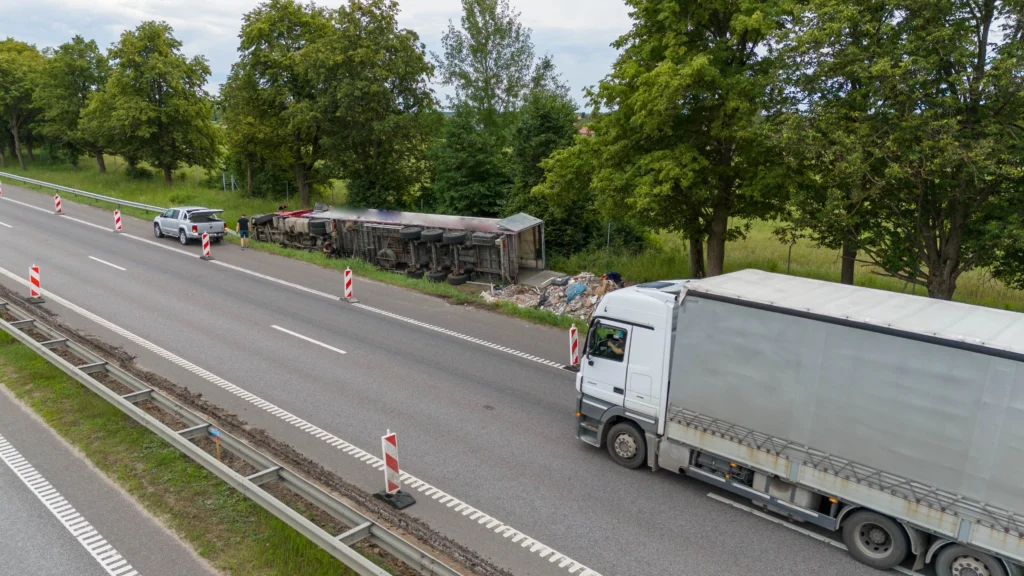
A driver was killed Monday night after a pickup truck struck the rear of a tractor-trailer on northbound I-35W in Fort Worth.
According to the Fort Worth Police Department, the crash occurred just after 9 p.m. at the ramp connecting I-35W to U.S. Highway 287. Investigators determined that the pickup hit the back of the semitrailer and then lost control. The pickup driver was pronounced dead at the scene. All northbound lanes were shut down for several hours while crews cleared the wreckage.
The victim’s identity has not yet been released. The cause of the crash remains under investigation.
At first glance, rear-end crashes may seem straightforward. But when a commercial truck is involved — especially a tractor-trailer — liability is rarely simple. And for surviving family members, understanding what actually happened becomes critical.
Rear-End Collisions With Semi-Trucks Are More Complex Than They Appear
Many people assume that if a pickup strikes the back of a semi-truck, the pickup driver is automatically at fault.
That’s not always true.
Commercial trucks operate under different rules and standards than passenger vehicles. Several factors can turn a “rear-end crash” into a much deeper legal investigation:
- Was the tractor-trailer stopped in an unsafe location?
- Were proper hazard lights or reflective markings visible?
- Was the trailer equipped with compliant underride guards?
- Was the truck merging, slowing, or blocking the ramp?
- Were weather or lighting conditions a factor?
Nighttime highway ramps — like the I-35W to U.S. 287 connector — present visibility challenges. If a trailer is improperly illuminated or stopped unexpectedly, the risk of catastrophic impact increases dramatically.
Underride crashes are especially dangerous. When a smaller vehicle strikes the rear of a trailer, the front of the vehicle can slide underneath the trailer body. These collisions frequently result in fatal head or upper-body trauma.
That’s why federal regulations require specific safety equipment and visibility standards for commercial trailers.
When someone dies in a crash involving a semi-truck, investigators must look beyond surface assumptions.
Potential Liability in Texas Semi-Truck Fatalities
In Texas, fatal truck accidents trigger wrongful death and survival claims. These claims allow surviving family members to pursue compensation when negligence contributed to the death.
Even if the pickup struck the trailer from behind, several parties may still be examined for liability:
- The Truck Driver — Unsafe lane changes, abrupt slowing, failure to signal, or improper vehicle positioning can contribute to fault.
- The Trucking Company — Commercial carriers must hire qualified drivers, maintain vehicles, and comply with Federal Motor Carrier Safety Administration (FMCSA) regulations. Poor training or supervision may establish corporate negligence.
- Maintenance Providers — Brake light failures, missing reflective tape, or defective underride guards can increase crash severity.
- Other Contributing Factors — Road design, visibility conditions, or mechanical issues may also be investigated.
Texas follows a modified comparative negligence rule, meaning fault can be divided among multiple parties. Even if the pickup driver bears some responsibility, other contributing negligence can still impact the outcome of a claim.
Every detail matters in fatal crash investigations.
The Financial and Emotional Impact of Fatal Truck Accidents
When a life is lost in a highway collision, families face more than grief. They face long-term financial consequences.
Wrongful death claims in Texas may include compensation for:
- Funeral and burial expenses
- Loss of financial support
- Loss of companionship and guidance
- Emotional anguish
- Loss of inheritance
- Medical expenses prior to death
Crashes involving commercial vehicles typically involve higher insurance coverage limits than standard passenger vehicle accidents. However, that also means insurers fight aggressively to limit payouts.
Trucking companies often deploy response teams immediately after serious accidents to secure evidence and protect their interests.
Critical evidence can include:
- Black box (event data recorder) information
- Electronic logging device (ELD) records
- Dashcam footage
- Driver qualification files
- Maintenance and inspection records
- Dispatch communications
If not preserved quickly, this evidence can disappear.
Time is critical in these cases.
How The Burkett Law Firm Handles Fatal Truck Accident Cases
Truck accident litigation requires a focused understanding of commercial transportation law, federal safety regulations, and complex insurance structures.
The Burkett Law Firm represents families across Texas in serious and fatal truck accident cases by providing:
Thorough, Immediate Investigation
The firm works quickly to preserve electronic data, request maintenance logs, and analyze crash reconstruction findings. In rear-end semi collisions, visibility compliance, lighting requirements, and vehicle positioning are carefully evaluated.
Identifying All Responsible Parties
Truck cases often involve more than just the driver. The firm investigates corporate policies, hiring practices, safety records, and prior violations to determine whether systemic negligence played a role.
Strategic Damage Evaluation
Fatal accident cases require careful calculation of long-term financial losses. The Burkett Law Firm documents lost earning capacity, projected financial contributions, and emotional harm suffered by surviving family members.
Trial-Ready Advocacy
Insurance companies negotiate differently when they know a firm is prepared for trial. Being trial-ready strengthens settlement leverage and protects families from undervalued offers.
Moving Forward After a Fatal Semi-Truck Crash
The Fort Worth I-35W crash remains under investigation. Until official findings are released, the full circumstances are unknown.
What is clear is this: collisions involving 80,000-pound commercial vehicles are rarely simple. And families deserve clarity — not assumptions.
Texas law generally provides two years from the date of death to file a wrongful death claim. Waiting too long can jeopardize critical evidence and legal rights.
If you have lost a loved one in a semi-truck crash in Fort Worth or anywhere in Texas, consulting an experienced truck accident attorney can help you understand:
- Whether negligence may have contributed
- What compensation may be available
- What immediate steps should be taken
The Burkett Law Firm offers consultations to help families navigate complex truck accident cases with strength and direction.
When commercial vehicle negligence leads to tragedy, accountability matters.
