

The Burkett Law Firm represents people hurt in 18-wheeler and commercial truck crashes in Corpus Christi, Nueces County and the Coastal Bend. We investigate the driver, the trucking company and every other responsible party under federal and Texas trucking rules. Consultations are free, and we work on contingency, with no fee or case costs unless we win.
We also represent people hurt in 18-wheeler crashes on highways across South Texas, including I-37, US-77 and the Eagle Ford Shale routes. Learn more on our Texas truck accident lawyer page.
The Burkett Law Firm at a glance
- Serving Corpus Christi and the Coastal Bend since 1960, across three generations of Burkett attorneys.
- David Burkett has been licensed in Texas since 1978 and Board Certified in Personal Injury Trial Law by the Texas Board of Legal Specialization since 1993.
- Injury cases are handled on contingency: no attorney fee unless we recover for you.
- Office: 538 S. Tancahua St., Corpus Christi, TX 78401. Phone: 361-882-8822. Se habla español.
- Serving Corpus Christi, Nueces County, Portland, Alice, Rockport, Kingsville and the rest of the Coastal Bend.
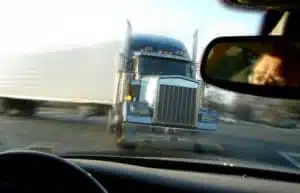
Our firm has represented injured people in Corpus Christi since 1960, across three generations of Burkett attorneys. David Burkett is Board Certified in Personal Injury Trial Law by the Texas Board of Legal Specialization and works with attorneys Nathan Burkett and Eddie Perez. We handle claims involving tractor-trailers, tankers, flatbeds, dump trucks, cement trucks, box trucks and other commercial vehicles throughout Portland, Robstown, Calallen, Kingsville, Alice, Rockport and the rest of the Coastal Bend.
Why is truck traffic so heavy around Corpus Christi?
Corpus Christi is a freight town. In its 2025 annual tonnage report, the Port of Corpus Christi said customers moved 203.4 million tons through the Corpus Christi Ship Channel in 2025 and described the port as the third largest in the United States in total waterborne tonnage. The port, the refineries and petrochemical plants along the Ship Channel, and the oil and gas fields inland all generate heavy truck traffic.
That traffic concentrates on a few corridors:
- I-37, the main route between the port, Refinery Row and San Antonio, with heavy tanker and flatbed traffic
- US-77, running south through Robstown and Kingsville toward the Rio Grande Valley
- US-181 and the Harbor Bridge, connecting downtown and the port area to Portland and San Patricio County
- South Padre Island Drive (SPID / TX-358) and the Crosstown Expressway (TX-286), where trucks mix with dense commuter traffic
- TX-44, carrying industrial and oilfield traffic west toward Robstown and Alice
TxDOT’s 2025 crash data shows what that traffic means on the road.
| Commercial motor vehicle crashes, 2025 (TxDOT) | Nueces County | Texas |
|---|---|---|
| CMV-involved crashes | 320 | 38,533 |
| People killed | 3 | 528 |
| Suspected serious injuries | 7 | 1,611 |
Source: TxDOT, Commercial Motor Vehicle (CMV) Involved Crashes and Injuries by County, calendar year 2025.
What causes truck accidents on Coastal Bend highways?
The crashes we investigate usually trace back to one or more of these problems:
- Driver fatigue from long hauls, tight delivery windows and hours-of-service violations
- Speeding and following too closely, especially on I-37 and US-77, where a fully loaded truck cannot stop in time
- Unsafe lane changes and wide turns in blind spots on SPID, the Crosstown and the ramps near the Harbor Bridge
- Distraction, including phones, dispatch messages and in-cab screens
- Overloaded or poorly secured cargo, including shifting liquid loads in tankers leaving the refineries
- Brake, tire and lighting failures caused by skipped inspections or poor maintenance
- Impaired driving involving alcohol, drugs or stimulants
- Inexperienced or poorly trained drivers hired without proper background checks
We cover the most common crash types in more detail in our guides to jackknife truck accidents, blind spot truck accidents, rear-end truck collisions, fatigued trucker crashes and distracted truck driver crashes.
How is a truck accident case different from a car accident case?
A loaded tractor-trailer can weigh many times as much as a passenger car and needs far more distance to stop, so the injuries are usually far worse. The legal case is different too:
- Federal safety rules apply. Interstate carriers must follow the Federal Motor Carrier Safety Regulations, and Texas applies many of the same standards to intrastate carriers. A violation can be strong evidence of negligence.
- More parties can be responsible. The driver, the motor carrier, the trailer owner, the shipper or loader, a maintenance shop and a parts manufacturer may all share fault.
- More insurance is in play. Commercial carriers must carry much higher liability limits than ordinary drivers.
- The defense moves fast. Trucking companies and their insurers often send investigators to the scene within hours.
- Texas has special trial rules. Since 2021, Chapter 72, Subchapter B of the Civil Practice and Remedies Code has governed how many commercial vehicle cases are tried, as explained below.
What federal trucking rules matter after a crash?
The Federal Motor Carrier Safety Administration (FMCSA) sets detailed rules for commercial drivers and carriers. The ones that come up most often in crash cases are:
- Hours of service (49 C.F.R. Part 395): limits on how long a driver can drive and stay on duty
- Driver qualification (Part 391): licensing, medical certification, road tests and driving history checks
- Drug and alcohol testing (Part 382): pre-employment, random and post-crash testing
- Cargo securement (Part 393): how loads must be tied down and balanced
- Inspection, repair and maintenance (Part 396): brakes, tires, lights and required inspection records
Driver fatigue is one of the most common problems we see. Under 49 C.F.R. § 395.3, property-carrying drivers must follow these limits:
| Hours-of-service rule | Limit |
|---|---|
| Driving limit | 11 hours of driving after 10 consecutive hours off duty |
| On-duty window | No driving after the 14th hour after coming on duty |
| Required break | 30 minutes after 8 cumulative hours of driving |
| Weekly limit | 60 hours on duty in 7 days or 70 hours in 8 days |
| Restart | 34 or more consecutive hours off duty resets the weekly clock |
Most carriers must track these hours with an electronic logging device (ELD). When a driver’s logs, fuel receipts and GPS data do not line up, that gap can show the driver was over hours, falsifying records or both.
What evidence proves a truck accident case, and how do you keep it from disappearing?
Trucking cases are won with records, and many of those records are controlled by the trucking company. Key evidence includes:
- Engine control module (“black box”) data showing speed, braking, throttle and cruise control in the seconds before impact
- ELD and hours-of-service records, along with dispatch logs, fuel receipts, toll records and delivery times
- GPS and telematics data and forward-facing or driver-facing camera video
- The driver qualification file, including driving history, medical certification and prior violations
- Drug and alcohol test results from post-crash testing
- Maintenance and inspection records for the tractor and trailer
- Bills of lading and load records showing weight and who loaded the cargo
Time is the enemy. Federal rules require carriers to keep records of duty status and supporting documents for only six months (49 C.F.R. § 395.8(k)(1)), and some electronic data can be overwritten far sooner. That is why we send a preservation demand, often called a spoliation letter, to the carrier and its insurer right away. The letter puts them on notice that a claim is coming and that they must keep the truck, the data and the documents. Under the Texas Supreme Court’s decision in Brookshire Bros., Ltd. v. Aldridge, 438 S.W.3d 9 (Tex. 2014), a party with a duty to preserve evidence that destroys it can face sanctions, including, when the evidence was destroyed intentionally (or, rarely, when negligent loss leaves the other side unable to present its case), an instruction telling the jury to presume the missing evidence would have hurt that party.
Who can be held liable for an 18-wheeler crash?
Truck crashes often have more than one cause. Depending on the facts, responsible parties may include:
- The truck driver, for speeding, fatigue, distraction, impairment or unsafe lane changes
- The motor carrier, which is generally responsible for its driver’s negligence on the job and may also be liable for its own failures in hiring, training, supervision or maintenance
- The owner of the tractor or trailer, if different from the carrier
- The shipper or loading company, for overloaded, unbalanced or poorly secured cargo
- A maintenance or repair shop, for brake, tire or lighting work done wrong
- A truck or parts manufacturer, for defective components
- A government entity, in limited cases involving dangerous road conditions, which generally requires notice within six months under Tex. Civ. Prac. & Rem. Code § 101.101
Identifying every party matters because each one may have separate insurance, and Texas law assigns a percentage of responsibility to each.
What Texas laws control a truck accident claim?
| Rule | What it means | Source |
|---|---|---|
| Filing deadline | Most injury and wrongful death lawsuits must be filed within two years | Tex. Civ. Prac. & Rem. Code § 16.003 |
| 51% bar | You can recover if you are 50% or less at fault, reduced by your share | Tex. Civ. Prac. & Rem. Code §§ 33.001, 33.012 |
| Texas intrastate carrier insurance | At least $500,000 in liability coverage for most carriers operating vehicles over 26,000 pounds | 43 Tex. Admin. Code § 218.16 |
| Interstate carrier insurance | At least $750,000 for for-hire carriers of general freight in vehicles of 10,001 pounds or more; $1,000,000 for oil and certain hazardous materials; $5,000,000 for certain bulk hazardous materials | 49 C.F.R. § 387.9 |
| Bifurcated trials | The defense can ask to try liability and compensatory damages first, and exemplary damages in a second phase | Tex. Civ. Prac. & Rem. Code § 72.052 |
| Regulation evidence | Evidence of a safety violation is admissible in the first phase only if it tends to show the violation was a proximate cause of the injury | Tex. Civ. Prac. & Rem. Code § 72.053 |
| Exemplary damages cap | Punitive damages for gross negligence are capped, with exceptions for certain felony conduct such as intoxication assault | Tex. Civ. Prac. & Rem. Code § 41.008 |
The 2021 changes in Chapter 72 shape how we prepare a case. If the trucking company stipulates that its driver was an employee acting within the scope of the job, its liability for the driver’s ordinary negligence generally rests on that employment relationship alone (§ 72.054). Claims about the company’s own conduct, such as negligent maintenance, and claims for exemplary damages are preserved.
What should you do after a truck accident in Corpus Christi?
Call 911, get medical care and, if you can, photograph the truck, its trailer, the company name and the USDOT number on the cab door. Get witness names. Do not give a recorded statement to the trucking company’s insurer, and do not sign anything before talking with a lawyer. Our guide on what to do after a truck accident on I-37 covers these steps in more detail, including how to get the crash report.
What compensation can you recover after a truck crash?
Truck crashes often cause catastrophic harm, including traumatic brain injuries, spinal cord injuries, amputations, crush injuries and burns. Texas law allows you to recover:
- Past and future medical expenses, including surgery, rehabilitation and long-term care
- Lost wages and lost earning capacity
- Physical pain and mental anguish
- Physical impairment and disfigurement
- Property damage
When a crash takes a life, the Texas Wrongful Death Act allows the surviving spouse, children and parents to bring a claim (Tex. Civ. Prac. & Rem. Code § 71.004). Our wrongful death attorneys help families pursue full compensation for lost support, companionship and grief. Where a carrier knowingly put a dangerous driver or truck on the road, exemplary damages may also be available.
How does The Burkett Law Firm build a truck accident case?
The Burkett Law Firm treats every truck case as one that may go to trial, because that is how fair settlements get made.
- We act immediately. We send preservation letters, request the crash report and identify the carrier through its USDOT number and FMCSA records.
- We get the data. We pursue the black box download, ELD logs, dispatch records, camera video and maintenance files, and we work with accident reconstruction specialists when the facts are disputed.
- We audit the carrier. We review the driver qualification file, drug and alcohol testing, inspection history and any prior safety violations.
- We find all the coverage. That includes the carrier’s primary and excess policies, other responsible parties and your own UM/UIM coverage.
- We prove the full cost of your injuries. We work with your doctors and, when needed, life care planners and economists to show what your future care and lost income will cost.
What results has The Burkett Law Firm obtained?
The Burkett Law Firm has recovered more than $80,000,000 for clients. Published results include:
- $5,000,000 in a trucking case
- $20,000,000 in a commercial van wrongful death case
- $5,750,000 in a company vehicle rollover case
Every case is different, and past results do not guarantee a similar outcome.
Frequently asked questions about Corpus Christi truck accident claims
How long do I have to file a truck accident lawsuit in Texas?
Most truck accident injury lawsuits must be filed within two years of the crash, and wrongful death lawsuits within two years of the death, under Tex. Civ. Prac. & Rem. Code § 16.003. The practical deadline is much shorter, because key trucking records may be kept for only six months and some electronic data can be lost sooner. Calling a lawyer in the first days after the crash gives you the best chance of preserving that evidence.
Who pays for my injuries after an 18-wheeler crash?
Usually the trucking company’s commercial liability insurer pays, because the carrier is generally responsible for its driver’s negligence on the job. Other parties, such as a loader, a trailer owner or a maintenance company, may also have coverage.
What is a truck’s black box, and can I get the data?
Most heavy trucks have an engine control module that records speed, braking and other data around a crash. That data belongs to the trucking company, so it usually must be obtained through a preservation demand and the legal process. We move quickly to make sure it is saved.
Can I recover if the trucking company says I was partly at fault?
Yes, if you are found 50% or less responsible. Your damages are reduced by your share of fault, and you recover nothing if you are found more than 50% at fault. Trucking insurers often argue that a car cut off the truck, which is why independent evidence like black box data and video matters.
Should I talk to the trucking company’s insurance adjuster?
It is best not to give a recorded statement or sign any release before speaking with a lawyer. The adjuster works for the trucking company, and early statements are often used to dispute fault or downplay injuries. Once you hire us, we handle all communication with the carrier and its insurer.
How much does it cost to hire a truck accident lawyer?
The Burkett Law Firm works on contingency, so there is no up-front cost. Our fee is paid from the recovery only if we win your case. You also pay no case costs unless compensation is recovered. The first consultation is free.
When should you call a Corpus Christi truck accident lawyer?
Call as soon as you have received medical care. The first days after a truck crash are when black box data, logbooks and video are most at risk, and when the trucking company is already building its defense. You should have someone doing the same for you.
The Burkett Law Firm offers free consultations and handles truck accident cases on contingency, with no fee and no case costs unless we recover compensation for you. Call (361) 882-8822 or contact The Burkett Law Firm to speak with an attorney. Our office is at 538 S Tancahua St, Corpus Christi, TX 78401.
Reviewed by David Burkett, Board Certified, Personal Injury Trial Law – Texas Board of Legal Specialization



