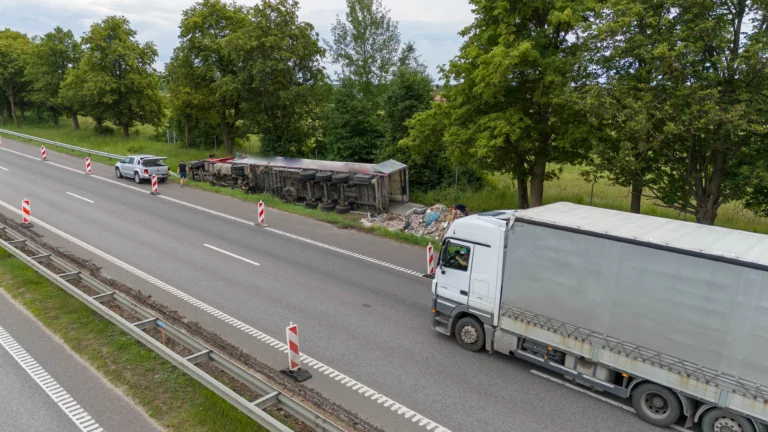


Texas is built on highways—freight, construction, oilfield traffic, and constant interstate flow. That also means Texas sees a steady stream of serious semi-truck wrecks. Some are headline-grabbing pileups. Others are “ordinary” rear-end collisions that turn fatal because of the sheer size and stopping distance of an 18-wheeler.
If you’ve been hit by a semi (or lost someone you love), the legal process is not like a normal car accident claim. The cause matters, the evidence disappears quickly, and the defense side often starts building its case immediately.
Below are the most common causes of semi-truck accidents in Texas, paired with real Texas incidents and the legal lessons they point to.
Why Texas truck crash data matters
Texas tracks statewide crash reporting and publishes statistics through TxDOT’s crash reporting systems and its Traffic Safety Data Portal. This matters because it’s the backbone for understanding trends—and it’s also where lawyers and investigators often start when pulling official reports and crash records.
1) Speed, following too closely, and “couldn’t stop in time”
A fully loaded semi can weigh up to 80,000 pounds. Even at highway speeds, a small miscalculation in following distance can be deadly. Rear-end crashes are especially common when traffic slows unexpectedly near construction zones, interchanges, or during late-night driving when attention drops.
A recent example: the Texas Department of Public Safety reported a fatal crash in Glasscock County on February 17, 2026, where a Chevrolet Silverado hit the rear of a tractor-trailer’s trailer and caught fire, killing the pickup driver. While DPS noted the pickup “failed to control speed,” crashes like this still underline a core truth: when big rigs are involved, the margin for error is tiny—and speed/distance decisions are often central to liability analysis.
Legal takeaway: In many semi-truck cases, the fight becomes about who had the last clear chance to avoid impact, whether traffic conditions were predictable, and whether the truck driver/company had proper safety procedures (lighting, reflective tape, safe turning practices, etc.). Determining fault requires the crash report plus physical evidence, ECM/telematics data, and often reconstruction.
2) Impairment and unsafe driving decisions in heavy traffic zones
Impairment is not limited to alcohol. It can include drugs, prescription medication misuse, and extreme fatigue that functionally mimics intoxication.
One of the clearest recent Texas examples is the deadly multi-vehicle crash on I-35 in North Austin (March 13, 2025). FOX 7 Austin reported the truck-tractor driver was arrested and charged with multiple counts including intoxication manslaughter and intoxication assault.
That same crash has been widely reported as involving many vehicles, including semis, and occurring in/near a work zone—exactly the kind of environment where one bad decision becomes a mass-casualty event.
Legal takeaway: If impairment is suspected, early legal action is crucial to preserve evidence (bodycam, blood testing records, dispatch communications, ELD logs, and surveillance). Waiting can mean losing the cleanest proof.
3) Fatigue and hours-of-service pressure
Driver fatigue is a major factor in large truck crashes nationwide. FMCSA materials citing the Large Truck Crash Causation Study indicate that fatigue was identified in a meaningful share of serious crashes and that Hours-of-Service rules were designed specifically to reduce fatigue-related incidents.
Fatigue is especially relevant in Texas because long rural stretches and overnight freight routes create the perfect conditions for microsleeps and delayed reaction times—particularly when schedules are tight.
Legal takeaway: Fatigue cases aren’t proven by vibes. They’re proven with records—electronic logging devices (ELDs), fuel/receipt timestamps, dispatch messages, GPS pings, and sometimes driver phone data. A strong truck case often hinges on forcing preservation and production of these records before they’re “lost” in routine retention cycles.
4) Load issues, spills, and roadway hazards that trigger secondary crashes
Even when a semi doesn’t directly strike another vehicle, cargo loss or a crash that creates debris can lead to secondary collisions, injuries, and freeway closures.
Example: the Houston Chronicle reported a crash involving a truck that hit an overpass and spilled roughly 900–1,100 pounds of hay onto U.S. 59, causing closures during cleanup; during the response, a police officer in a patrol car was struck by another vehicle that broke through barricades.
This is a real-world illustration of how a “single-vehicle” commercial incident can create a dangerous chain reaction for everyone else on the roadway, including first responders.
Legal takeaway: Cargo securement, route planning, and safe operations around overpasses/interchanges can all become litigation issues. If you’re hurt in a secondary crash, liability may still trace back to the commercial vehicle—depending on foreseeability, warnings, and whether the hazard was properly handled.
5) Failure to keep a proper lookout and preventable intersection/impact events
Some of the most tragic semi-truck crashes involve straightforward failures: the truck driver didn’t see a vehicle, misjudged distance, or didn’t react in time. These show up in head-on collisions, left-turn crashes, and impact crashes where the truck’s size turns a mistake into a fatal outcome.
A recent Texas example (reported by a Victoria-area injury law site citing local police): a semi-truck crash on U.S. Highway 59 North allegedly involved a tractor-trailer striking an SUV, resulting in three fatalities.
(For any claim, you’d still rely on the official crash report and investigation, but incidents like this illustrate the stakes when a semi’s mass meets a passenger vehicle.)
Legal takeaway: Commercial cases often hinge on visibility, speed, braking, lane position, and whether the truck driver had adequate training and supervision. This is where dashcam footage, nearby business cameras, ECM data, and reconstruction can make or break the claim.
Compensation isn’t automatic: proof and proximate cause still control outcomes
Victims understandably assume “big truck = big payout.” Sometimes that’s true. But Texas law still requires proof of negligence and proximate cause—and big verdicts can be reduced or wiped out on appeal.
A major example: the Texas Supreme Court decision in Werner Enterprises, Inc. v. Blake (2025) reversed and rendered judgment for the defense, holding the truck driver’s conduct was not a substantial factor/proximate cause of the crash under the facts presented.
What that means for real people: Your case needs clean causation. It needs preserved evidence. And it needs a strategy that anticipates the defenses (sudden emergency, third-party fault, unavoidable conditions, comparative negligence, etc.).
How The Burkett Law Firm can help after a semi-truck accident in Texas
Semi-truck cases move fast—because the defense side moves fast. The Burkett Law Firm can help by taking immediate steps to protect your claim, including:
- Preserving evidence early: spoliation letters, court orders if needed, and rapid investigation to secure dashcam/ELD/telematics before it disappears.
- Identifying every liable party: driver, carrier, broker, shipper, maintenance contractor, and potentially others depending on the facts.
- Building a damages case that holds up: not just current medical bills, but future treatment, lost earning capacity, and the human impact of the injury.
- Negotiating from leverage: insurers don’t pay fairly because you’re hurt—they pay when the proof is strong and trial risk is real.
Bottom line
Semi-truck accidents in Texas are often preventable. The most common causes—speed/following distance, impairment, fatigue, cargo issues, and lookout failures—show up again and again in real incidents across the state.
If you were hit by a semi-truck, don’t treat it like a normal car wreck. Evidence and liability are different. And the outcome can swing dramatically based on what’s preserved in the first days.