

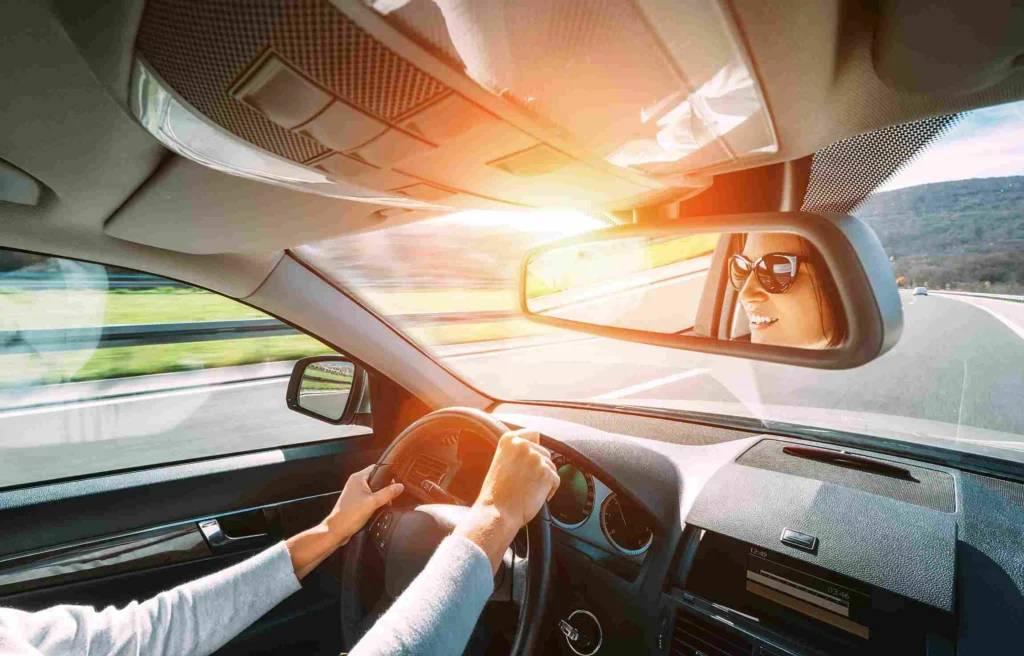
Sun glare rarely excuses a crash under Texas law. A driver who cannot see the road must still slow down, keep a safe distance and stop if needed. The Burkett Law Firm represents people hurt in sun glare crashes in Corpus Christi and holds at-fault drivers responsible, even when they blame the sun.

Is a driver at fault if the sun was in their eyes?
Usually, yes. Glare is a road condition, like rain or fog, and Texas expects drivers to adjust to the conditions in front of them. Two traffic rules come up in almost every glare case:
- Safe speed. Tex. Transp. Code § 545.351 bars driving faster than is “reasonable and prudent” under the conditions and hazards that exist, and it requires drivers to control their speed as needed to avoid a collision.
- Following distance. Tex. Transp. Code § 545.062 requires a driver following another vehicle to keep an assured clear distance, so the driver can stop safely without hitting the vehicle ahead.
A driver who heads into a low sun at full speed, or who stays close behind another car while partly blinded, is not meeting either duty. The common explanation, “I never saw them,” often confirms that the driver kept going without being able to see what was ahead.
Fault still turns on the facts. A second careless driver, a vehicle stopped without lights in a travel lane, or your own conduct can all affect how responsibility is divided. That is why a glare case needs a careful look at the timing, the direction of travel and how each driver reacted.
How does sun glare cause crashes?
Glare works in two ways. Disability glare from a low sun washes out a driver’s view of brake lights, traffic signals and people in the road. Discomfort glare causes squinting and looking away, which costs the driver seconds of attention at the worst possible moment. A dirty or pitted windshield scatters light and makes both problems worse, and a wet road after a Coastal Bend rain shower can reflect the sun back up into the driver’s eyes.
The same patterns show up again and again in glare collisions:
| Crash type | What glare does | Who is usually at fault |
|---|---|---|
| Rear-end | Hides brake lights and slowing traffic ahead | The trailing driver, who must keep an assured clear distance |
| Left turn at an intersection | Hides oncoming cars, especially when the turning driver faces the sun | The turning driver, who must yield to oncoming traffic |
| Pedestrian or cyclist | Washes out a person in a crosswalk or on the shoulder | The driver, in most cases |
| Missed signal or stop sign | Makes a red light or stop sign hard to read | The driver who entered the intersection |
| Lane drift or sideswipe | Driver loses track of lane lines and nearby vehicles | The driver who left the lane |
Glare can play a part in many types of car accidents, especially rear-end and left-turn crashes.
When is sun glare worst in Corpus Christi?
Glare is worst in the first hour or so after sunrise and the last hour or so before sunset, when the sun sits low enough to slip under the visor. The timing shifts through the year, so a commute that is easy in July can be dangerous in November. The end of daylight saving time makes it worse, because it moves the evening drive home closer to sunset.
Local geography adds to the problem. Much of Corpus Christi sits west of the bay, the Laguna Madre and Padre Island, so morning drivers heading east toward the water often face a rising sun, and the evening trip west reverses it. Commuters on long stretches of SPID (South Padre Island Drive) toward Flour Bluff, drivers coming into downtown on I-37, and anyone crossing open stretches with no trees or buildings to block the light know how quickly the road ahead can disappear.
State crash data gives a sense of the timing. TxDOT’s 2025 statewide crash statistics on light conditions list 6,268 crashes at dawn and 6,200 at dusk. Light-condition categories do not measure glare directly, and glare also strikes in full daylight whenever the sun is low on the horizon, so those totals are a partial picture.
Can the other driver blame the sun to avoid paying?
They can try. Defense lawyers sometimes ask for an “unavoidable accident” jury instruction in glare cases. The Supreme Court of Texas has said that instruction is proper only when the evidence shows the crash was caused by a nonhuman condition and not by anyone’s negligence (Hill v. Winn Dixie Texas, Inc., 849 S.W.2d 802 (Tex. 1992)). A driver who could have slowed down, pulled over or stopped usually cannot meet that standard.
The more common defense is to shift part of the blame to the injured person. Texas uses proportionate responsibility under Chapter 33 of the Texas Civil Practice and Remedies Code. Your recovery is reduced by your share of fault, and under § 33.001 you cannot recover at all if you are more than 50 percent responsible. Our guide to the Texas 51% comparative fault bar explains how those percentages get argued. In a rear-end crash where the trailing driver was blinded, that driver typically carries most or all of the fault.
What evidence proves a sun glare crash?
Glare cases depend on the exact time and direction of travel, so evidence needs to be gathered quickly:
- The precise time and location of the crash, which let an expert calculate where the sun was in the sky
- The crash report, including any statement that a driver “didn’t see” the other vehicle
- Photos taken from the at-fault driver’s direction of travel, ideally at the same time of day
- Dash camera footage and video from nearby businesses
- Vehicle event data showing speed and braking in the seconds before impact
- Witness accounts of how fast the other driver was going and whether they slowed
- Your medical records, starting with your first visit after the crash
A Corpus Christi car accident lawyer can send preservation letters for video and vehicle data before they are recorded over or lost. The Burkett Law Firm can also bring in a reconstruction expert when the other side disputes what a driver could see.
What if a pedestrian, cyclist or motorcyclist was hit?
People outside a car are the hardest to see in glare and the most likely to be badly hurt. A driver turning into the sun may never pick out a motorcycle’s narrow profile or a pedestrian stepping into a crosswalk. These crashes often cause fractures, head trauma and spinal injuries. If you ride, our page on motorcycle accident claims covers how fault and insurance work for riders.
What can you recover, and how long do you have?
A glare crash claim can include medical bills, future care, lost wages, reduced earning capacity, physical pain, mental anguish and property damage. When a crash is fatal, eligible family members may bring a claim under the Texas Wrongful Death Act, Chapter 71 of the Civil Practice and Remedies Code.
Most Texas personal injury and wrongful death claims must be filed within two years under Tex. Civ. Prac. & Rem. Code § 16.003. Our Texas personal injury statute of limitations guide covers the exceptions.
If the driver who hit you has no insurance or too little, your own uninsured/underinsured motorist coverage may pay the difference. Texas insurers must offer that coverage under Tex. Ins. Code § 1952.101, and it is part of your policy unless you rejected it in writing. Our guide on being hit by an uninsured driver in Texas explains how those claims work.
How can drivers lower the risk of a glare crash?
- Keep the windshield clean inside and out, and replace worn wiper blades.
- Use the sun visor and polarized sunglasses on sunrise and sunset drives.
- Slow down and add following distance when facing a low sun.
- Watch the cars ahead, and brake when they brake.
- Shift your commute by a few minutes if your route points straight into the sun.
When should you call a lawyer after a sun glare crash?
Call as soon as you have received medical care, especially if you were hurt, the other driver blames the sun, or an insurer is asking for a recorded statement. Glare evidence depends on the exact time and conditions, and business video is often erased within days.
Since 1960, The Burkett Law Firm has represented injured people across Corpus Christi, Nueces County and the Coastal Bend. Lead attorney David Burkett is Board Certified, Personal Injury Trial Law – Texas Board of Legal Specialization. Personal injury cases are handled on contingency, so you pay no attorney’s fee and no case costs unless the firm recovers compensation for you. Call (361) 882-8822 or contact The Burkett Law Firm to set up a free consultation about your glare crash.
Reviewed by David Burkett, Board Certified, Personal Injury Trial Law – Texas Board of Legal Specialization
