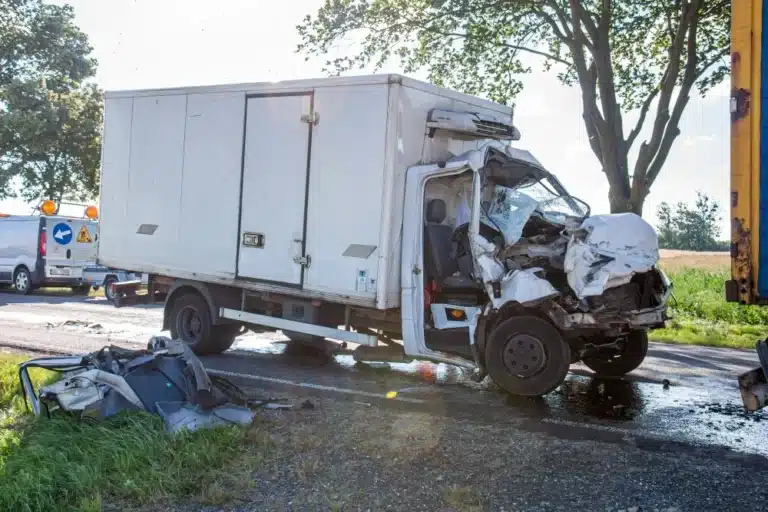


A 29-year-old Texas man was seriously injured after a semi-truck rollover in Meade County, Kansas, highlighting how quickly heavy truck accidents can turn catastrophic.
According to the Kansas Highway Patrol, the crash occurred on February 25, 2026, at approximately 4:45 p.m. A 2005 Peterbilt semi driven by Nathaniel Rosas of Muleshoe, Texas, was traveling northbound on K23 near Meade Lake when the driver failed to negotiate a curve. The truck and trailer overturned and slid into a ditch. Rosas was transported to Meade District Hospital with suspected serious injuries. Authorities also reported that he was not wearing a seatbelt at the time of the crash.
Although this crash occurred outside Texas, it involved a Texas driver operating a commercial vehicle, and the circumstances mirror rollover accidents that happen regularly on Texas highways.
Semi-truck rollovers are among the most dangerous types of commercial vehicle crashes. And they are rarely random.
Semi-Truck Rollovers Are Often Preventable — Here’s Why They Happen
A fully loaded semi-truck has a high center of gravity. That makes it inherently less stable than a passenger vehicle — especially during sharp turns, sudden steering corrections, or when traveling too fast for roadway conditions.
Common causes of rollover crashes include:
- Entering curves at excessive speed
- Overcorrecting steering
- Shifting or improperly secured cargo
- Brake imbalance
- Driver fatigue or distraction
- Poor roadway design or lack of warning signage
In the Meade County crash, the report indicates the driver “failed to negotiate the turn.” That phrase often points to speed miscalculation, unfamiliar roadway geometry, or distraction.
In Texas, rollover crashes frequently occur:
- On rural highways
- Along oilfield transport routes
- Near interchanges and feeder roads
- On exit ramps
- In construction zones
Texas sees thousands of commercial vehicle crashes each year. The combination of long-haul routes, heavy freight traffic, and expanding infrastructure makes semi-truck stability a constant safety concern.
When a semi overturns, the consequences are severe:
- Cab crush injuries
- Spinal trauma
- Traumatic brain injury
- Ejection (particularly when seatbelts are not worn)
- Multi-vehicle secondary collisions
Rollover accidents are among the leading causes of serious injury in commercial trucking incidents.
The Role of Seatbelts in Commercial Truck Accidents
The Kansas Highway Patrol reported that the Texas driver was not wearing a seatbelt at the time of the crash.
Seatbelt use among commercial drivers has improved over the years, but non-use still contributes to injury severity. In rollover crashes, especially, failure to wear a restraint dramatically increases the risk of:
- Being thrown within the cab
- Impacting the windshield
- Partial or full ejection
- Head and neck trauma
In Texas, commercial drivers are required by law to wear seatbelts. However, in civil cases, seatbelt use can also become a litigation issue.
If a truck driver is injured and was not wearing a seatbelt, defense attorneys may argue comparative negligence — claiming the injuries were worsened by the driver’s own failure to use proper restraints.
But that does not automatically eliminate liability.
If vehicle instability, mechanical failure, improper cargo loading, or company pressure contributed to the crash, the trucking company or other third parties may still bear responsibility.
Seatbelt non-use can affect damages. It does not automatically erase fault elsewhere.
When a “Single-Vehicle” Semi Crash Isn’t So Simple
At first glance, this appears to be a one-vehicle accident.
But in commercial trucking, even single-vehicle crashes can involve multiple layers of liability.
Questions that matter:
- Was the driver operating under safe hours-of-service limits?
- Was fatigue a factor?
- Was the load properly secured and balanced?
- Were the brakes and suspension systems maintained correctly?
- Was the roadway properly marked for curve speed warnings?
- Did the employer provide adequate training for route navigation?
In Texas-based trucking operations, drivers often work long routes under tight deadlines. If dispatch communications or electronic logging device (ELD) data show unrealistic scheduling expectations, that can shift focus toward employer negligence.
Additionally, cargo loading errors can create uneven weight distribution — significantly increasing rollover risk during turns.
Injury claims involving semi rollovers frequently require:
- ECM (engine control module) data analysis
- Event data recorder review
- Load weight documentation
- Maintenance logs
- Driver qualification files
- Company safety policies
Without early legal intervention, those records can become difficult to obtain.
How The Burkett Law Firm Helps After a Semi-Truck Rollover
Whether the injured party is a commercial driver or a civilian harmed in a rollover-related collision, truck accident cases require aggressive and informed legal strategy.
The Burkett Law Firm helps clients by focusing on four key priorities:
Immediate Investigation
Semi-truck evidence disappears quickly. Electronic logs can be overwritten. Internal reports can be sanitized. Early legal action preserves critical data.
Identifying All Responsible Parties
Even when a driver makes an error, liability may extend to the trucking company, cargo handlers, maintenance providers, or others involved in the operation.
Accurate Damage Evaluation
Serious rollover injuries often require long-term treatment. Spinal injuries, orthopedic trauma, and brain injuries can affect earning capacity permanently. A proper claim accounts for future care — not just current medical bills.
Strategic Negotiation or Litigation
Trucking companies and their insurers act fast to minimize exposure. Having experienced legal representation ensures you are not pressured into accepting a settlement before understanding the full scope of your injuries.
The Bigger Safety Lesson for Texas Drivers
The Meade County rollover is a reminder of how unforgiving heavy trucks can be.
A single misjudged turn.
A moment of distraction.
A missed safety step.
And a fully loaded semi overturns.
Texas drivers share the road daily with commercial trucks weighing up to 80,000 pounds. While many operate safely, the margin for error is small — especially in curves, construction zones, and rural highways.
If you are injured in a semi-truck accident — whether as a driver or another motorist — do not assume the situation is straightforward.
Truck accident cases are different from standard car wrecks. They involve federal regulations, company policies, technical vehicle data, and layered insurance coverage.
The sooner legal guidance is sought, the stronger the position for recovery.
The Burkett Law Firm represents individuals injured in commercial vehicle crashes throughout Texas. If you or someone you love has suffered serious injuries in a semi-truck accident, a consultation can clarify your rights and your next steps.
Heavy truck crashes change lives in seconds.
Accountability ensures they don’t define the rest of yours.