

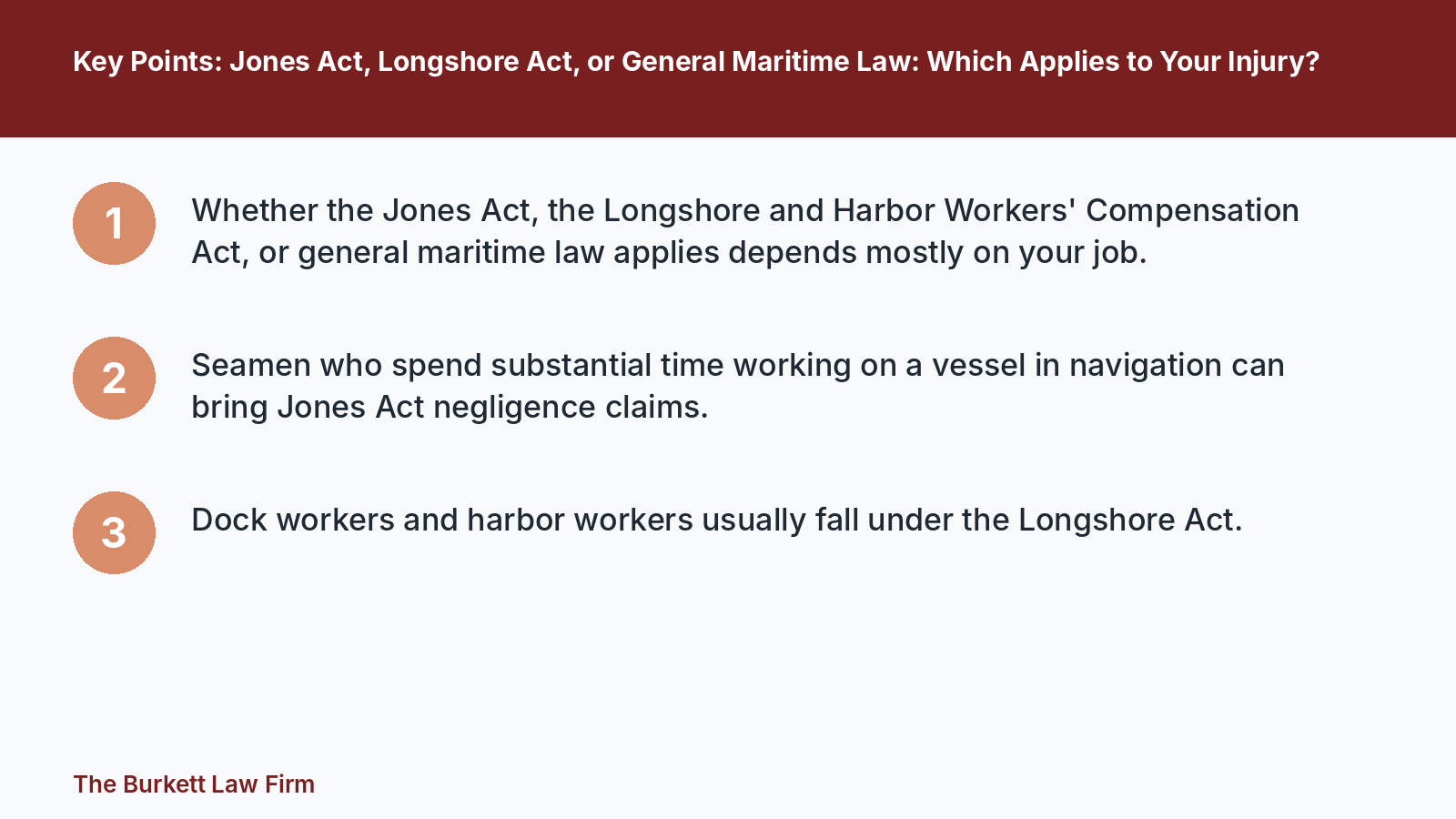
Whether the Jones Act, the Longshore and Harbor Workers’ Compensation Act, or general maritime law applies depends mostly on your job. Seamen who spend substantial time working on a vessel in navigation can bring Jones Act negligence claims. Dock workers and harbor workers usually fall under the Longshore Act. Passengers and visitors often rely on general maritime law.
Reviewed by David Burkett at The Burkett Law Firm. Last reviewed November 2026.
Corpus Christi is one of the busiest ports in the country. Thousands of people work on tugs, supply boats, barges, dredges, offshore vessels, and docks along the Coastal Bend. When someone is hurt on or near the water, the first question is not just who was at fault. It is which body of law applies, because that choice shapes the entire claim.
This guide follows our earlier discussion of maintenance and cure and explains how the three main systems differ.
Why the Classification Matters
Federal maritime law offers different remedies to different workers. A Jones Act seaman can sue the employer for negligence and recover full damages, including pain and suffering. A worker covered by the Longshore Act generally receives no-fault benefits from the employer and cannot sue the employer for negligence, though claims against third parties may remain. Getting the classification right at the start protects the strongest available remedy.
Who Qualifies as a Jones Act Seaman
Courts generally apply a two-part test from Chandris v. Latsis:
- The worker’s duties must contribute to the function of a vessel or the accomplishment of its mission.
- The worker must have a connection to a vessel or fleet of vessels in navigation that is substantial in both duration and nature.
A common guideline is that a worker who spends about 30 percent or more of their working time on a vessel in navigation may meet the duration requirement. Deckhands, captains, engineers, cooks, and many offshore crew members often qualify. The Burkett Law Firm handles these claims through its Jones Act practice.
What the Jones Act Provides
A Jones Act seaman can recover damages if employer negligence played any part, even the slightest, in causing the injury. Recoverable damages may include lost wages, loss of future earning capacity, medical expenses, and pain and suffering. Seamen are also entitled to maintenance and cure regardless of fault, and they may bring an unseaworthiness claim against the vessel owner when the vessel or its equipment was not reasonably fit.
Who the Longshore Act Covers
The Longshore and Harbor Workers’ Compensation Act generally covers maritime workers who are not seamen, including:
- Longshore workers loading and unloading vessels
- Shipbuilders and ship repairers
- Harbor workers and dock crews
- Some workers on piers, wharves, and adjoining terminal areas
The Longshore Act provides medical care and a portion of lost wages without requiring proof of fault. In exchange, the covered employer is generally protected from negligence lawsuits by the employee. A Longshore worker may still sue a vessel owner for vessel negligence under section 905(b), or another third party whose negligence caused the injury.
General Maritime Law
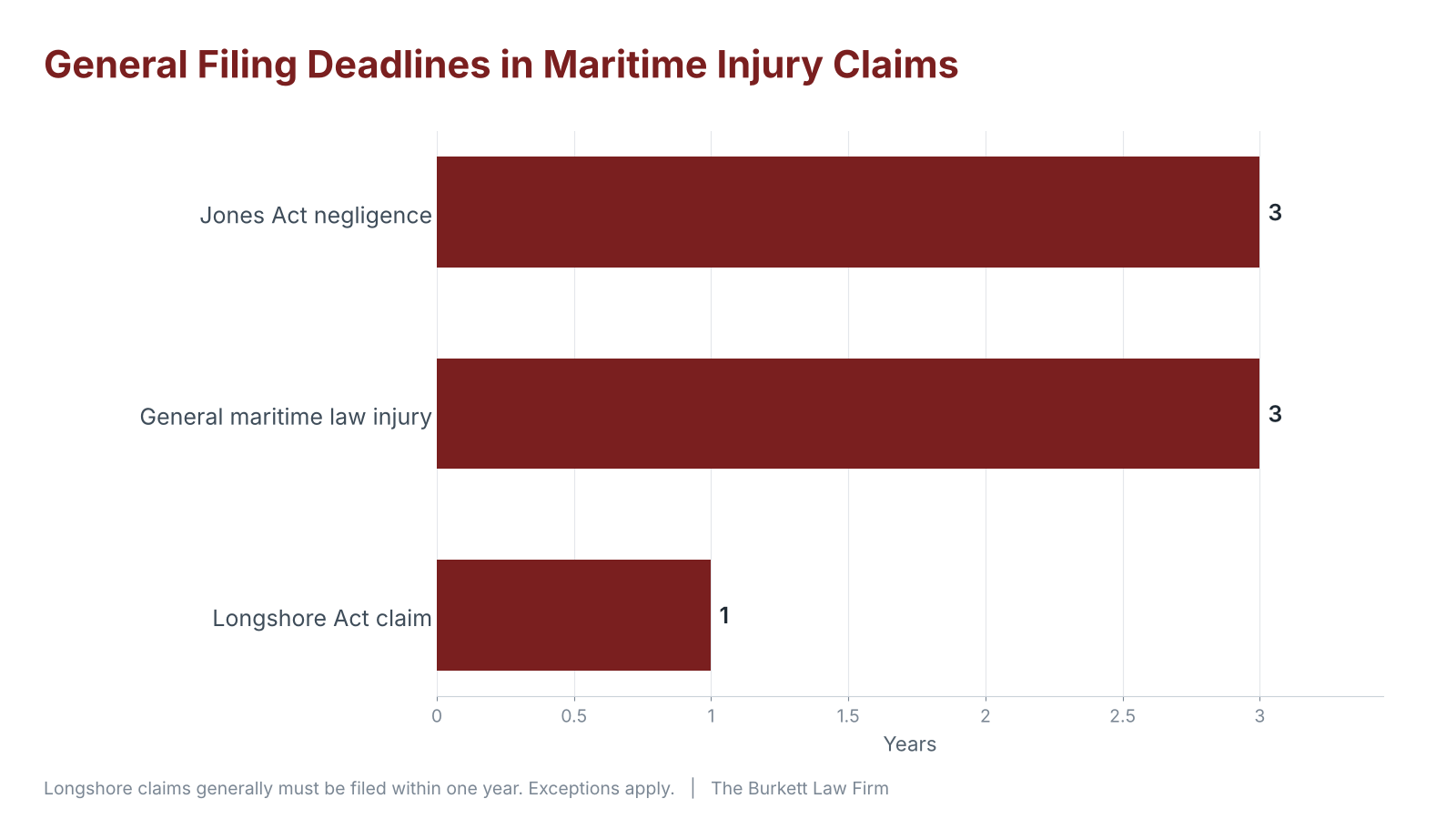
General maritime law fills gaps. It covers passengers on boats, recreational boaters, and visitors injured on vessels, and it supplies the unseaworthiness and maintenance and cure doctrines for seamen. People hurt on charter boats, ferries, or cruise excursions often bring claims under general maritime law. These claims may have their own deadlines, often three years for many maritime personal injury claims.
Gray Areas and Disputes
Classification fights are common. Employers sometimes argue that a worker is a Longshore worker rather than a seaman to limit liability. Workers who split time between docks and vessels, crews on jack-up rigs, and workers on barges that rarely move often face these disputes. Courts look at the worker’s entire employment, not just the moment of injury, which is why job records and assignment logs matter.
How Courts Have Applied These Rules
Several United States Supreme Court decisions shape how maritime injury claims are handled today:
- Chandris v. Latsis (1995) set the two-part seaman status test and endorsed the 30 percent rule of thumb for time spent on a vessel in navigation.
- Harbor Tug and Barge Co. v. Papai (1997) held that a worker hired for short, one-off jobs on vessels lacked the substantial connection needed for seaman status.
- Stewart v. Dutra Construction Co. (2005) held that a dredge used to dig a channel was a vessel, opening the door to Jones Act claims for its crew.
- Lozman v. City of Riviera Beach (2013) held that a floating home that was not designed for transportation was not a vessel.
- The Dutra Group v. Batterton (2019) held that punitive damages are not available for unseaworthiness claims.
These cases show how much turns on the facts: what the structure is, how the worker spends their time, and which claim is brought. Applying them to a specific job is where experienced maritime counsel makes a difference.
Steps to Protect a Maritime Injury Claim
- Report the injury to the captain or supervisor in writing.
- Get medical care and keep copies of every record.
- Write down the vessel name, location, and witnesses.
- Be careful with statements you give to the company or its insurer.
- Keep records showing how much time you spend on vessels.
Early legal review helps determine which law applies and which deadlines control. Our Corpus Christi maritime attorneys can help sort out these questions.
If you can, photograph the area where you were hurt, including equipment, deck conditions, and lighting. Keep copies of any accident report you sign and ask for a copy if one was made without you. Talk to a maritime lawyer before giving a detailed recorded statement, because early statements are often used to argue about seaman status or fault.
Do not assume the company’s classification of your job is correct. Whether you are a seaman or a Longshore worker affects every remedy, and that decision is made under the law, not by your job title.
Frequently Asked Questions
What is the difference between the Jones Act and the Longshore Act?
The Jones Act lets seamen sue employers for negligence. The Longshore Act provides no-fault benefits to dock and harbor workers.
How do I know if I am a Jones Act seaman?
Generally, you must contribute to a vessel’s mission and have a substantial connection to a vessel in navigation.
Can a Longshore worker sue anyone?
Yes. Longshore workers can often sue vessel owners or other third parties whose negligence caused the injury.
What is the deadline for a Jones Act claim?
Generally, three years from the injury.
Does general maritime law cover passengers?
Yes. Passengers and visitors injured on vessels often bring claims under general maritime law.
What defenses do employers raise in maritime injury claims?
Common defenses include arguing the worker was not a seaman, that the worker’s own negligence reduced the damages, that the injury did not happen as described, or that a pre-existing condition caused the problem.
Talk to a Corpus Christi Maritime Injury Lawyer
The Burkett Law Firm represents seamen, dock workers, and passengers injured on the water throughout Corpus Christi and the Coastal Bend. When you call, our team will ask about your job, the vessel, and how the injury happened, then explain which law applies and what you may recover. Learn more about our Corpus Christi Jones Act lawyers.
